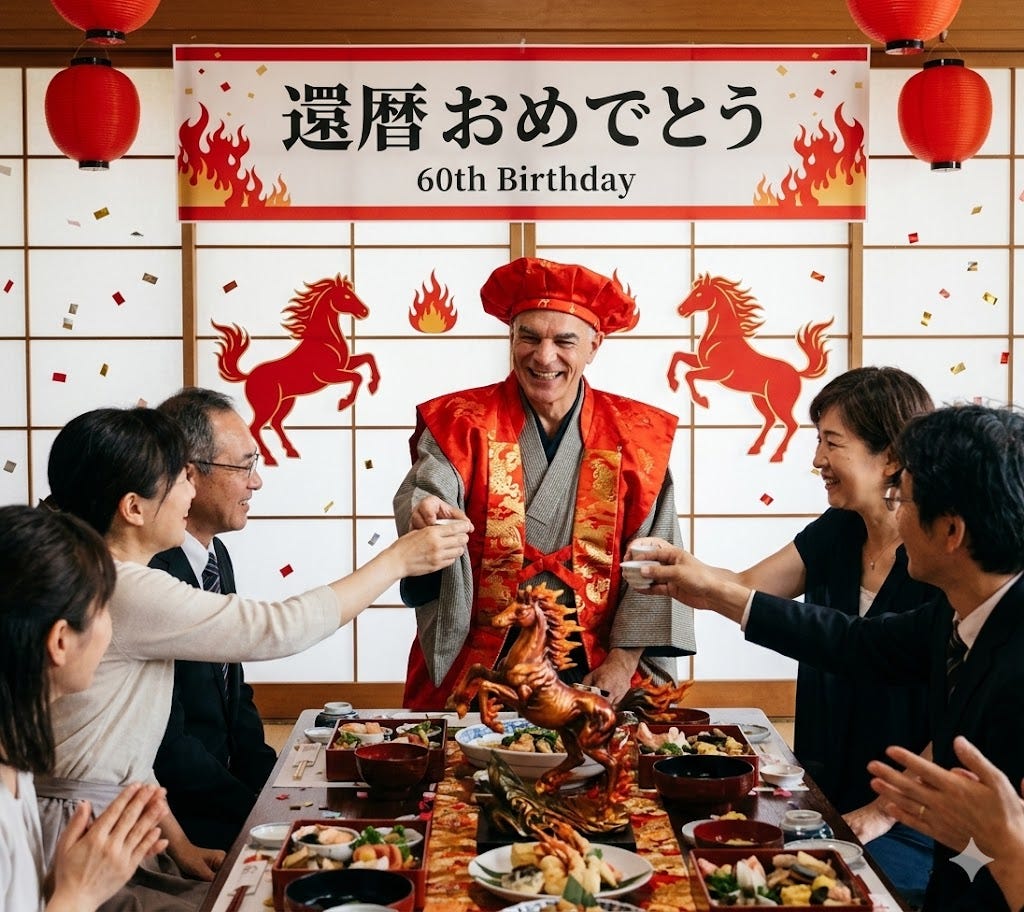
Happy birthday to me. I'm 60 years old today on May 4th. In the West, that's Star Wars day, but in the East it has great symbolic significance. I spent 10 years living in Japan. And in Japan it's Kanreki. Kan is the return, and reki is the calendar. You are going back to your birth year: because there's 12 animals in the Chinese Zodiac, and there are five elements: wood, fire, earth, metal, and water. And so once you've done 60 years, you come back to the fire horse in my case, which is the year of my birth. Now in Japan, it's pretty auspicious. You dress in red just like you do like a baby. This t-shirt is the closest thing to red clothing that I actually own to celebrate today and it feels like a rebirth. You've done all the years and now you have the second go round. In China, it's called Dashou. Da is long or Da is big, and shou is life. And it's also meant to be the great longevity: you've reached 60 already, but it has a connotation that you've gotta be a little bit more careful. Apparently you have to wear a red underwear or red thread through your clothing just to be on the safe side, because the year of your birth, every 12 years, and by extension five times 12, the big, the great return is more dangerous.
All of my work, I've realised over the last 40 years that I've been doing philosophy has been about transformation. Transformation: we change the form. And it's because all of life is basically change and transformation. In fact, if something doesn't move or doesn't change at all. It's basically dead. Life is change. Life is constant change in time, and yet the way we deal with this change is through structures. These can be mental structures that we make about the world, language, concepts. These can be institutions. They can be physical institutions like countries or parliaments or buildings. They can be virtual institutions like money or laws, all the things that humans have created and have invented to deal with this amazing story of humanity, this very strange, absurd experience of being alive, and being able to think that we're alive, being self-conscious of the fact that we're alive.
I've always been drawn to this constructivist way of looking at the world. It's a combination: do we discover things in the world or do we invent them? New mathematics, new system, new symbols. Is it a discovery or is it an invention? And yet the things that we construct our world with, for example, the system of money, that's a construction, it's a social construction. The systems of laws are social constructions. The system of how we live, how we spend our time, what we consider as normal. In my travels around the world, not just the West, like the United States, but the East and Japan and my interest in lots of different countries, I realised these structures are different. Every great society over the centuries, over the millennia has invented different structures. They understand the world differently.
How is this related to the work I'm doing now and what I want to be doing in the future? I work with reframing, which is changing these frames, changing our understanding, and mostly I do this with organisations and companies where we look at their assumptions about customers, about teams, about communication, about AI these days. How do we work together? I find that there's many well-meaning people who work very hard and yet the system, the result is often suboptimal. It's often incredibly ineffective, at least as an outsider. Of course, I'm not within the system, but from the outside it seems like we're doing a lot of unnecessary and very frustrating work. With my tool and my workshop, we start looking at these things and making it less frustrating, and trying to break through some of these systematic structures.
Now personally, we also have patterns. We have patterns from our childhood. We have scripts that we've inherited, and often we are stuck as well. I'm an optimist by nature. I'm a fire horse, so I've always been looking for: how can we go from suboptimal? Optimal, I think is not possible. But how can we make it easier, better, more fun, more exciting?
At the same time, as I'm getting older, I also realise the cost involved, the cost of not doing it, the cost of not working on our personal patterns, because they get worse as we get older. Somebody once told me, when you are young, the pattern is drawn in sand, and you can change it easily. You get a bit older, the pattern is drawn in wood and you're going to have to chip away at it. And once you get old, the pattern is set in stone and then it's going to be very hard to change it. Changing these patterns that don't serve us on a personal level matters a great deal. To change these patterns at an organisational, at a team level, in a sector also matters to become more effective, to make the things that help us thrive as humanity.
But the thing I'm most fascinated about is how these really large patterns work. The world economic system. How we've decided the system of money and investment and debt and the relationship between nations. How do we see the history of humanity? How do we see how we've come from the millennia in the past. We've developed all these institutions: language, money, politics, et cetera. Anything you can imagine that we've created. And so that's been my fascination.
And moving forward, I want to talk more and in a more outspoken way about these things I see on a very large scale. Because I think after 40 years of doing this and after doing all my years, I've earned the right to speak about it. I think the rebirth is not so much as a hardworking person who is very serious about the world, but more playful, in looking at the absurd structures that we've made in the world and seeing, calling out the madness of some of the stuff we're doing.
Hopefully with a sense of compassion. I'm not suggesting we should have done it differently or we could have done it differently, or we must do it differently, but I do want to point out that we're leaving a lot of opportunities on the table, that we are very ineffective, that there is a lot of potential that we're not using.
And I also want to point out the price that we're paying for this. The price we're paying on an individual level, the price we're paying with organisations and the price we're paying as a society: we could have a thriving humanity on a thriving planet. This human story, this human arc that we are building, the history of humanity is something that we're writing all the time. We are co-authors, we are involved, as we're alive and we deal with change and with transformation.
We're gonna have some more discussions about this, some more ideas about the future, some more transformative insights, some playful, some compassionate, some slightly scolding ways of looking at the big picture. I hope you'll join me for some of it. Thank you.